

IPTV for Beginners: Everything You Need to Know Before Getting Started
 rankandrentempire@gmail.com
2 Sep 2026
11 min de lecture
rankandrentempire@gmail.com
2 Sep 2026
11 min de lecture
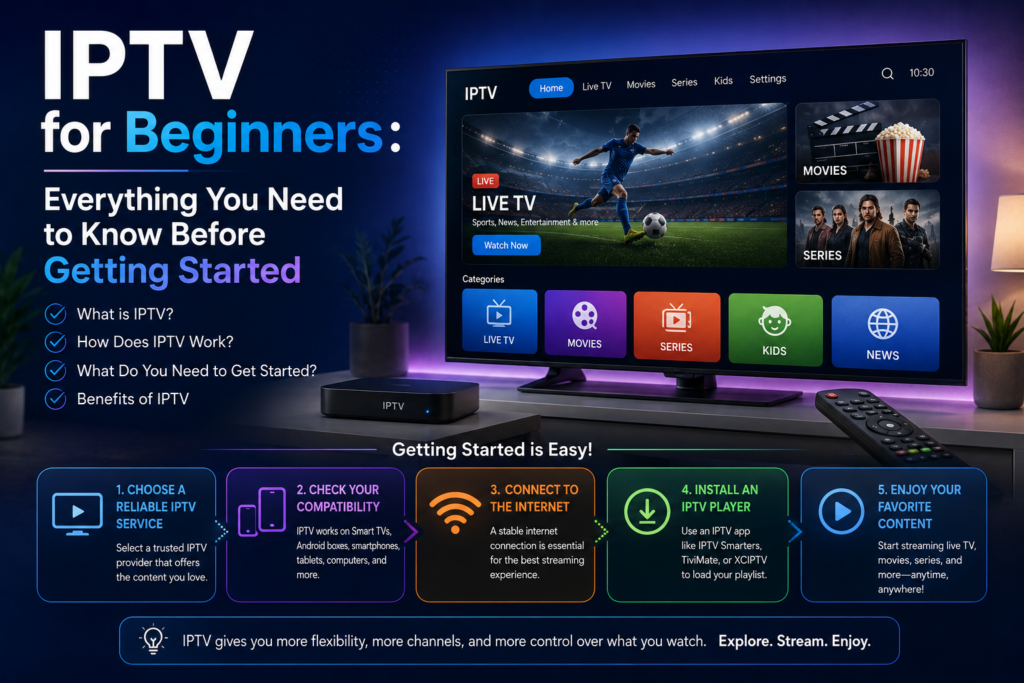
If you are new to IPTV, the technology may seem complicated at first. However, getting started is usually much easier than expected.
IPTV has become an increasingly popular way to watch television through an internet connection. Instead of relying on a satellite dish, IPTV delivers television channels and video content directly through the internet.
For viewers searching for IPTV South Africa, understanding the basics is important before choosing a service. This guide explains how IPTV works, what you need, how to choose a provider, and what to consider before subscribing.
What Is IPTV?
IPTV stands for Internet Protocol Television.
Simply put, IPTV delivers television content through an internet connection. Traditional television often depends on satellite, cable, or terrestrial broadcasting. IPTV uses internet technology instead.
This means you can watch live channels through compatible devices connected to your internet network.
IPTV can also include on-demand movies and series. Therefore, it can combine the experience of traditional television with modern streaming.
According to IPTVPass, IPTV can provide live television and on-demand content without requiring a satellite dish or decoder.
How Does IPTV Work?
IPTV works by sending video data through the internet.
First, television content is converted into a digital format. The provider then distributes that content through streaming servers.
When you select a channel, your IPTV application connects to the provider’s server. The server then sends the video stream to your device.
Your device receives the stream continuously while you watch.
The process is similar to watching online video. However, IPTV focuses heavily on live television channels and electronic programme guides.
Therefore, your internet connection plays an important role in the viewing experience.
What Do You Need for IPTV?
Getting started with IPTV does not require complicated equipment.
Generally, you need four basic things:
- A stable internet connection
- A compatible viewing device
- An IPTV application or player
- An active IPTV subscription
A Smart TV can often run an IPTV application directly. Alternatively, you can use an Android TV box, Fire Stick, smartphone, tablet, computer, or another compatible device.
For South African users, IPTVPass recommends a stable fibre, LTE, or 5G connection. Its setup information also provides different bandwidth recommendations for SD, HD, Full HD, and 4K streaming.
How Fast Should Your Internet Be?
Internet speed is one of the most important factors for IPTV.
A faster connection generally provides more room for high-quality streaming. However, speed is not the only factor.
Your connection should also be stable.
For example, a connection that constantly drops can cause buffering. Meanwhile, a stable connection can provide smoother playback.
As a general guide, IPTVPass recommends around 5 Mbps for SD, 10 Mbps for HD, 15–20 Mbps for Full HD, and 25 Mbps or more for 4K.
Your actual requirements can vary depending on the stream, household usage, and network conditions.
Which Devices Support IPTV?
One major advantage of IPTV is device flexibility.
Depending on the provider and application, you may be able to watch IPTV on:
- Samsung Smart TVs
- LG Smart TVs
- Hisense Smart TVs
- TCL Smart TVs
- Android TV boxes
- Amazon Fire Stick
- Android smartphones
- iPhones and iPads
- Windows computers
- Mac computers
- Apple TV
- Other compatible streaming devices
Therefore, you may not need to purchase a new television.
If you already own a compatible Smart TV or streaming device, setup can be relatively simple.
What Is an IPTV App?
An IPTV app is the software that allows your device to connect to an IPTV service.
The app usually displays your available channels and categories. Depending on the service, it may also provide an electronic programme guide and on-demand sections.
Popular IPTV players include applications such as IPTV Smarters Pro, TiviMate, XCIPTV, Flix IPTV, and VLC.
However, the available apps depend on your device and provider.
It is important to understand that an IPTV player and an IPTV provider are not the same thing.
The player displays the content. The provider supplies the subscription and streaming access.
IPTV Subscription vs IPTV App
This distinction often confuses beginners.
An IPTV application is simply a media player. Installing one does not automatically provide television channels.
You normally need a separate subscription containing your login or playlist information.
For example, a provider may give you login credentials and a server address. You then enter those details into a compatible IPTV application.
Therefore, installing an app alone is not enough.
What Can You Watch With IPTV?
The available content depends entirely on the provider.
Some services focus mainly on live television. Others offer sports, international channels, movies, series, news, and entertainment.
A broad IPTV service may include both local and international programming.
For South African viewers, local content can be particularly important. You may also want access to international channels from countries you regularly watch.
Before subscribing, always check the provider’s actual channel categories.
Do not choose a service based only on a large channel number.
Quality, reliability, content relevance, and legitimate licensing matter too.
IPTV for Sports Fans
Sports are one of the major reasons people explore IPTV.
Depending on the provider, IPTV services may offer sports channels covering football, rugby, cricket, motorsport, combat sports, golf, and other competitions.
However, availability can change.
Therefore, sports fans should check whether their preferred competitions are actually included before subscribing.
If you mainly watch rugby, for example, check rugby coverage specifically. If football is your priority, verify the relevant leagues and competitions.
This approach is much better than assuming every provider offers the same sports content.
IPTV South Africa: What Should Local Viewers Consider?
South African viewers have some specific considerations when choosing an IPTV service.
Internet quality can vary between locations. Fibre, LTE, and 5G can all provide useful options, but performance depends on your network and location.
Load shedding can also affect home internet equipment.
Therefore, it is worth considering your complete setup.
A reliable router, stable Wi-Fi, and suitable internet package can make a noticeable difference.
You should also consider whether the provider has support for South African customers.
Local currency pricing and responsive support can make the subscription experience easier.
For example, IPTVPass states that it uses local ZAR pricing and provides support for South African viewers.
How Much Does IPTV Cost?
IPTV pricing varies significantly.
Some providers offer inexpensive plans. Others charge more for additional features, higher-quality streams, or larger content libraries.
However, price should never be your only consideration.
A very cheap subscription may not provide the reliability you expect. Furthermore, advertised prices may sometimes apply only to introductory periods.
Before paying, check:
- Monthly price
- Renewal price
- Subscription duration
- Number of supported devices
- Simultaneous streaming limits
- Available channels
- Video quality
- Customer support
- Cancellation terms
For example, IPTVPass currently advertises plans priced in South African rand and states that it does not require a long-term contract.
Is IPTV Legal?
This is an important question for every beginner.
IPTV itself is simply a technology for delivering television through the internet. The legality of a specific service depends on the content it distributes and the rights or licences covering that content.
Therefore, you should evaluate the provider rather than assuming every IPTV service operates in the same way.
Before subscribing, look for clear information about the provider and its content rights.
You should also make sure your use complies with applicable South African laws and licensing requirements.
How to Choose a Reliable IPTV Provider
Choosing the right provider requires more than looking at the number of channels.
Start by checking the provider’s website.
Look for clear pricing, contact information, support options, device compatibility, and service details.
Next, examine the streaming infrastructure and reliability claims.
You should also check whether the provider offers a trial or another way to test the service before making a long commitment.
Customer support is another important factor.
If something goes wrong during setup, quick assistance can save considerable time.
Finally, consider whether the provider understands the needs of South African viewers.
What Makes a Good IPTV Experience?
A good IPTV experience depends on several factors working together.
Your internet connection needs to be stable. Your device needs enough performance to handle the stream. The application should work correctly.
At the same time, the provider needs reliable streaming infrastructure.
Some services use adaptive streaming technology. This can adjust video quality according to available bandwidth.
For example, IPTVPass states that its streaming system can adapt quality up to 4K UHD. It also describes load-balanced servers and automatic failover.
These features can help improve consistency when network conditions change.
How to Set Up IPTV
The basic setup process is usually straightforward.
Step 1: Choose Your Device
Decide where you want to watch.
Your Smart TV may be enough. Alternatively, you might prefer a Fire Stick or Android TV box.
Step 2: Choose an IPTV Provider
Compare providers carefully.
Check pricing, content, compatibility, support, reliability, and licensing information.
Step 3: Subscribe
After choosing a service, complete the subscription process.
You should receive the login information required by your IPTV application.
Step 4: Install a Compatible Player
Install an IPTV player supported by your device.
Make sure you download applications from legitimate sources whenever possible.
Step 5: Enter Your Login Details
Your provider may supply a username, password, and server URL.
Enter these details into the application.
Step 6: Start Watching
Once your playlist or account loads, browse the available categories.
Select a channel and test the playback quality.
If everything works correctly, your IPTV setup is ready.
How to Avoid IPTV Buffering
Buffering can happen for several reasons.
First, check your internet connection.
Next, test whether other devices are using large amounts of bandwidth.
You should also check your Wi-Fi signal.
If possible, place your streaming device closer to your router. An Ethernet connection can also provide more consistent performance on supported devices.
If buffering happens only on certain channels, the issue may be related to the provider or individual stream.
Therefore, test several channels before assuming your entire setup is faulty.
Common IPTV Mistakes Beginners Make
New users often make a few avoidable mistakes.
Choosing Only by Price
The cheapest option is not always the best option.
Instead, compare overall value.
Ignoring Internet Quality
Even an excellent IPTV provider cannot fix an unstable home connection.
Buying Without Checking Compatibility
Always confirm that the service works with your device.
Assuming Every Provider Is Identical
Providers can differ significantly in content, reliability, support, and legitimacy.
Skipping the Trial
If a legitimate trial is available, use it properly.
Test live channels, sports, different quality levels, and peak viewing periods.
IPTV vs Traditional Television
The biggest difference is how the content reaches your screen.
Traditional satellite television depends on satellite transmission and a dish. IPTV depends on an internet connection.
IPTV can provide greater flexibility because you can use different compatible devices.
However, that flexibility comes with a requirement for reliable internet.
Therefore, IPTV may be particularly attractive to households that already have a strong internet connection.
IPTV vs Netflix and Other Streaming Services
IPTV and services such as Netflix are not exactly the same.
Netflix and similar platforms focus mainly on on-demand entertainment.
You choose a movie or series and start watching it.
IPTV can focus heavily on live television.
This makes IPTV useful for viewers who want live sports, news, television channels, and scheduled programming.
Some IPTV services also provide on-demand libraries.
Therefore, the two formats can complement each other.
Final Checklist Before Getting Started
Before subscribing to an IPTV service, ask yourself:
- Is my internet connection stable?
- Is my device compatible?
- Does the provider offer the channels I actually watch?
- Is the pricing clear?
- Are renewal costs explained?
- Is customer support available?
- Can I test the service first?
- Does the provider explain its content rights?
- Does the service work well in South Africa?
- Can I cancel without unnecessary complications?
If the answers look positive, you are in a much better position to make an informed decision.
Start Your IPTV Journey
IPTV can be a convenient alternative for viewers who want flexible access to live television and on-demand content.
The technology itself is straightforward. The most important decision is choosing a suitable provider and ensuring that your internet and device can handle the service.
For viewers researching IPTV South Africa, it is worth comparing providers carefully instead of choosing the first option you find.
If you want to explore a South Africa-focused IPTV option, visit IPTVPass.co.za to review the available service, supported devices, setup information, and plans.
Remember, a successful IPTV setup starts with three things: reliable internet, compatible equipment, and a provider you can trust.
+32 000 chaînes & +150 000 films en 4K
Prêt à profiter de tout votre divertissement en un seul abonnement ? Activation immédiate, paiement par Wave, garantie satisfait ou remboursé.
Voir les abonnementsÀ lire aussi
 Uncategorized
Hello world!
Welcome to WordPress. This is your first post. Edit or delete it, then start writing!